Showing posts with label Research. Show all posts

Wednesday, 6 November 2013

Pete Buckingham; audience trends, profiles and patterns -

Page 1;
Q1 - Pete Buckingham suggests that the age and income influences audience patterns, he states that ages 15-24's represent 40% of cinema audiences. 35-44s make up 38% of cinema audiences showing that younger people go to the cinema more. More upmarket audiences with ABC1 jobs make up 60-66% of cinema audiences which will most likely be due to them being able to afford the experience. This shows truth in the statement 'the older the audience, the more upmarket' saying that they will be willing to pay for a more upmarket experience, such as an art house cinema or gallery seats. An audience with high paying jobs are likely to have more time on their hands as they usually will not have children or children living at home which is shown by long days at work, they will have more time and more money to spend on leisures. 55 plus make up 32% of light cinema goers.

Q2- I think i am a mixed kind of audience; i will go to see big blockbuster films as well as small company produced films, films with big or small star casts in it, different genres, different styles. I do usually go to the cinema to see a film if an actor i love stars in it as i am a quite loyal fan to certain actors and i will always come out of it loving the film, sometimes just because that certain actors is in it and maybe without them i may not have enjoyed it. I usually view films through the cinema if they are ones i feel will be worth the money, only being in part time work makes you look differently at spending money to see random films. Other than cinema viewing i will watch films online or through Love Film or Netflix which i subscribe to as it is not much money a month for the range of films that are available to watch. 
Blockbuster films; 
imgres.jpg

imgres.jpg


Q2b- To find out about viewing habits/successful genres and narratives i would either research online through websites, blogs and statistic websites. Also read through film audience articles and books.


Pages 3-4; 

Q3- 

A; I watch films because i enjoy the whole experience from it, especially the cinema experience. I like how films are an escapism from the real world and the exhilaration that comes from watching them and the fulfilled feeling you get when the film comes to an end. I like that in films there are people to admire, weather its the stars real life self or the character they are portraying there is always admiration towards at least one person. I enjoy seeing the creativity and imagination from the producers and directors and how this changes the film for better or worse, the power over judging if the films is good or not and what else could be done with it and the unexpected of what the film can contain.
Cinema experience;
imgres.jpg


B; The aspects that attract me to a film consist of the actors within it, i will go to see a film purely because there is an actor i love or admire starring in it. Also if a film is created by a company which i know the films they produce and exhibit are always enjoyable such as Warner Brothers i am more likely to go and pay to see it knowing that their films have a quality and good content. The reputation of a film matters to me and i am more likely to see a film which is represented well and which the audience who have already seen have enjoyed, also if a film i have seen is part of a trilogy i am more than likely going to go see the next films if the first one was enjoyable for example; the Harry Potter series, Lord of The Rings trilogy which i have seen and other film series i am planning to see after really enjoying the first film are The Hunger Games and The Hobbit.                  
                                  Actors that urge me to see films-the Harry Potter cast;
imgres.jpg
imgres.jpg  


C; I consume films in various ways, my most favourite being the cinema experience. i will also watch them online, stream them, watch them on t.v or buy the DVD. 
My favorite cinema;       
imgres.jpg


Q4; Drivers and Barriers - 
imgres.jpg
Drivers;                                           
Genre i like
Actors i like
Producers i like
Well known book
Everyones talking about it
Good and obvious hook
Surprising twist 
Sound track  
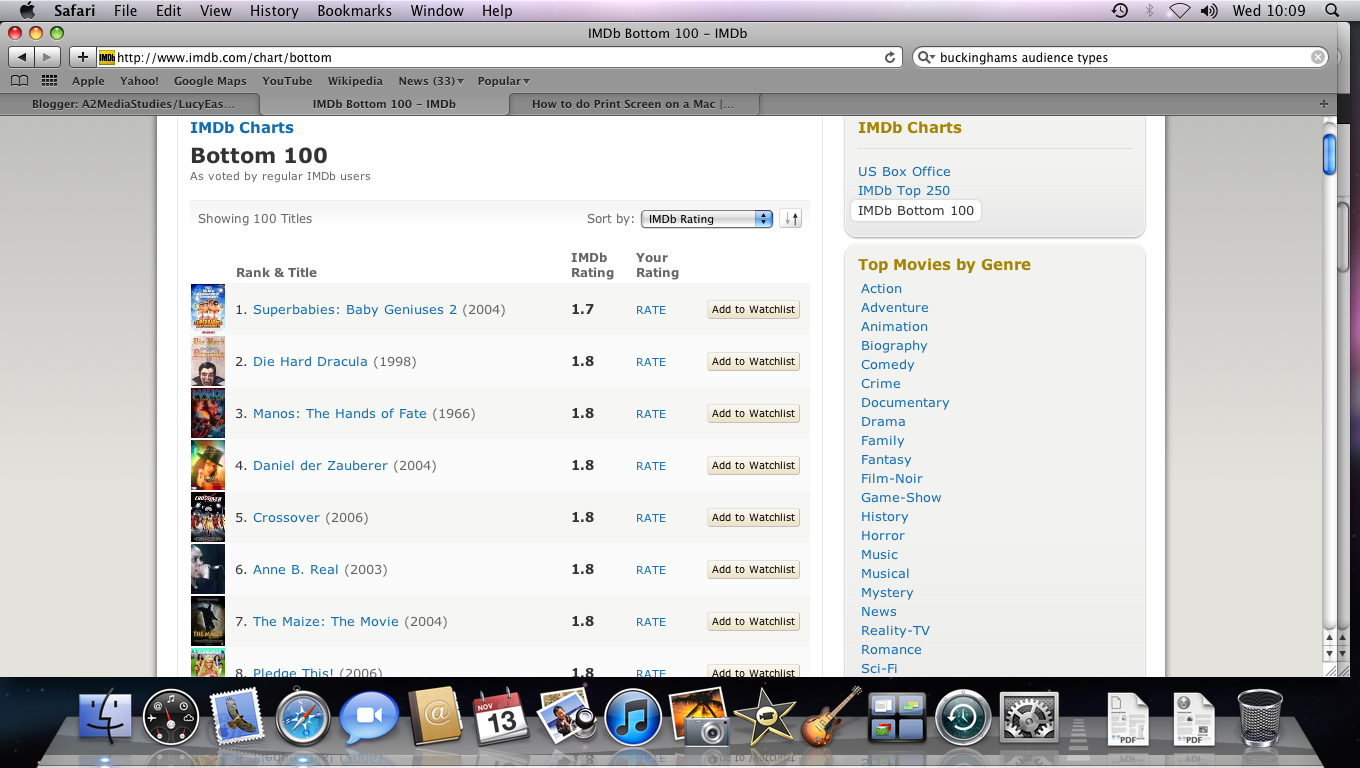
Barriers; 
Genres i dont like
No Big names and actors
Same few actors
Dont know the story
No one is talking about it -bad reviews 
No obvious hooks or surprising twist


I think all of the drivers above apply to me going to the cinema or to watch a film, not so much the well known book as i don't read much but every so often there will be a film or films from a book that i love, such as the Harry Potter film series. Pretty much all of the barriers would stop me from seeing a film apart from no big names or actors because i will watch a film even if it doesn't have any big names in it if it looks like it has a good quality and enjoyable storyline.

Thursday, 31 October 2013

Cut down prezi of audience types & theory's;

Assessment Criteria;

All of this information is from the OCR website: OCR Specification

  1. Research and planning 
    Level 4 16–20 marks 
    • Planning and research evidence will be complete and detailed. 
    • There is excellent research into similar products and a potential target audience. 
    • There is excellent work on shotlists, layouts, drafting, scripting or storyboarding. 
    • There is excellent organisation of actors, locations, costumes or props. 
    • Time management is excellent. 
    • There is excellent skill in the use of digital technology or ICT in the presentation. 
    • There are excellent communication skills. 
    • There is an excellent level of care in the presentation of the research and planning. 

  2. Evaluation
    Level 4 16–20 marks
    • There is excellent skill in the use of digital technology or ICT in the evaluation.
    • There is excellent understanding of the forms and conventions used in the productions.
    • There is excellent understanding of the role and use of new media in various stages of the production.
    • There is excellent understanding of the combination of main product and ancillary texts.
    • There is excellent understanding of the significance of audience feedback.
    • There is excellent skill in choice of form in which to present the evaluation.
    • There is excellent ability to communicate. 
  1. Production
    Film 
    Level 3 
    The candidate is expected to demonstrate proficiency in the creative use of most of the following technical skills: 
    • shooting material appropriate to the task set; including controlled use of the camera, attention to framing, variety of shot sizes and close attention to mise en scene 
    • editing so that meaning is apparent to the viewer and making selective and appropriate use of shot transitions, captions and other effects 
    • recording and editing sound with images appropriately.
  1. Level 4


  2. The candidate is expected to demonstrate excellence in the creative use of most of the following technical skills: 
    • shooting material appropriate to the task set; including controlled use of the camera, attention to framing, variety of shot sizes and close attention to mise en scene 
    • editing so that meaning is apparent to the viewer and making selective and appropriate use of shot transitions, captions and other effects 
    • recording and editing sound with images appropriately.

    Print
    Level 3
    The candidate is expected to demonstrate proficiency in the creative use of most of the following technical skills: 
    • awareness of conventions of layout and page design 
    • awareness of the need for variety in fonts and text size 
    • accurate use of language and register 
    • he appropriate use of ICT for the task set 
    • appropriate integration of illustration and text 
    • raming a shot, using a variety of shot distances as appropriate 
    • shooting material appropriate to the task set; selecting mise-en-scène including colour, figure, lighting, objects and setting 
    • manipulating photographs as appropriate, including cropping and resizing. 

    1. Level 4 
      The candidate is expected to demonstrate excellence in the creative use of most of the following technical skills: 
      • awareness of conventions of layout and page design 
      • awareness of the need for variety in fonts and text size 
      • accurate use of language and register 
      • the appropriate use of ICT for the task set 
      • appropriate integration of illustration and text 
      • framing a shot, using a variety of shot distances as appropriate 
      • shooting material appropriate to the task set; selecting mise-en-scène including colour, figure, lighting, objects and setting 
      • manipulating photographs as appropriate, including cropping and resizing.

Friday, 25 October 2013

Audiences;

 
Theory?
Definition
Cultivation
As audiences watch more and more film and television, they gradually develop certain views about the world, some of which are ‘false’.
Desensitization
If we are exposed to too much violence, or too much blatant sexuality, we will become less sensitive to real life violence and sexual behaviours.
Copycat
This approach suggests that people will imitate what they see in the media – e.g. if young people watch Natural Born Killers, they will go out on a killing spree. This is not so much a ‘theory’ as an assumption perpetuated by the Press!
Reception analysis
Audiences are seen as active producers of meaning, rather than as merely consumers of media meanings. They make sense of media texts according to their social position (in terms of their identity) – and their gender, race, class etc.
Uses and Gratifications
Instead of researching what the media do to the audience, this approach studies what the audience does with the media. This approach also takes account of people’s personalities and personal needs.
Hypodermic Syringe
Just like the syringe used to inject a drug into a body, the media ‘injects’ messages directly into the minds of the viewers/listeners/readers; and they can be as addictive as heroin ...

This box method has really helped me understand the different types of theory's for audiences in a clear and memorable way. I think that all of the theories above are true and agree with the impact they can have on society, as my short film will contain violence i believe the 'Desensitization' theory fits in to it. This is because there is a murder but to an outside audience watching this it wouldn't seem like a big deal as they are so used to seeing murders in films that it has become a common thing. 


Audiences;

Understanding audience theory;

Audience behaviour / patterns of consumption


Active - the audiences reacts and engages with the film positively and actively.


Passive- the audience is watching but they are not fully engaging with the film, for example a women is watching a film but glancing as a magazine at the same time.


Traditional- a person that will go to the cinema to watch films which are usually the same genre or that have the same actors/actresses starring in them.


Hedonist-


Post-modernist- someone who loves the arts and will view films in various modern ways, not only at the cinema. e.g; streaming, on t.v, online etc..


Main lesson focus:


defining audience – starting with Pete Buckingham article/ new audience groupings


Activities


1. Analyse the following terms and discuss until there is genuine understanding


Industry and institution ways of identifying


a. Preferred- a preferred way of hearing about and viewing a film.


b. Oppositional


c. Negotiated


d. Two-step flow- being told from another person who has already seen the film if it is good or not, if good this usually will persuade you to see it.


e. Distribution processes & exhibition


HYPODERMIC NEEDLE THEORY

direct influence via mass media
Or: Magic Bullet Theory
History and Orientation
The "hypodermic needle theory" implied mass media had a direct, immediate and powerful effect on its audiences. The mass media in the 1940s and 1950s were perceived as a powerful influence on behavior change.
Several factors contributed to this "strong effects" theory of communication, including:
- the fast rise and popularization of radio and television
- the emergence of the persuasion industries, such as advertising and propaganda
- the Payne Fund studies of the 1930s, which focused on the impact of motion pictures on children, and
- Hitler's monopolization of the mass media during WWII to unify the German public behind the Nazi party.


I think that people will look at examples of this theory in different ways depending on which genre of films they enjoy, such as for me i would used Harry Potter as an example to remember what effect the theory has on audience even though it was not in the time of the theory. This is because the film has a mass audience which react directly and with power to the film straight away, in which you would with an injection so to me it is a good rememberable example. 

The genre of my short film is thriller/horror, this could slightly fit in to the theory in that the audience will react straight away to the murder within it.
Through researching i feel i understand the focus of the lesson on;


Media Languages, Forms & Conventions
I feel that i understand the forms and conventions and i know what to put in to my short film so it fits the conventions of the genre which i have chosen, i need to use these so it is effective to the audience like other films in the genre.


    • Media Institutions Introduction

      I feel i know how the institutions use these theories to help make their films successful as well as using the different audience groupings to market the film so it attracts the correct audience which i will also do for my short film.

      •  Media audiences
      I have broadened my knowledge on media audiences through researching and looking in to Pete Buckingham's article. This has made me realise how much institutions look into many different aspects to research which audience is suitable for their film/media product. 

      • Media representations
      I have seen how media is represented differently by insitutions and producers.

      Monday, 21 October 2013

      Alan Cameron; modular narrative


      This is my narrative idea changed to fit the modular theory.

      The main characters are still a male and female, but their life's will be shown in separate scenes and link together in different ways in which they meet.
      I could have scenes showing the female character arguing with her parents which shows the audience the lead up to her being kicked out of her house and why it has happened.

      Also scenes of the male character either trying to or killing other women so the audience knows what he is like before he meets and murders the female character but this could lose the short films element of suprise.  

      Rather than meeting for the first time when the girl is upset, although this will still happen. They could walk past eachother in normal situations such as down a street or in a shop and maybe bump in to eachother showing they have seen and ignoliged eachother before. Then when they actually meet properly in the alley way they will recoginise eachother slightly which will give the girl more reason to go with him.

      Settings such as these would fit in this narrative idea;

      Narrative idea 2; Toderov's theory

      A state of equilibrium; 
      A shot of a house which we expect is a family home, the shot travels across the windows and door then to a long shot of the whole house.
      A disruption; 
      A teen girl gets kicked out of her house by her mother which is the opening scene of her slamming out of the door. Also another scene is shown of a male character strangling a women to death.

      A recognition of a disruption;
      The next scene is of her sitting crying in a dark alley way which makes the audience realise there is a problem in her life. This is from the male characters point of view as he is walking up to her, he asks if she wants to go for a drink and as she is vulnerable and wants help and company so she accepts.
      An attempt to repair the damage;
      They have a drink and chat then he offers for her to stay as his for the night and with him until she can find other family or friends to stay with. The audience are un sure if he is the male from the earlier shot as it was not completely clear what he looked like, they will start to think this character will look after the girl.


      The girl starts to realise the man is acting strangely and that he is a psycho. He chases through street into the woods trying to get to her. This is all from the male characters point of view.
      He gets hold of her at one point but she fights her way out and carries on running.
      A reinstatement of the equilibrium;
      The man starts shouting that the girl left her bag at the bar, she stops and realises he is a normal guy and they end up falling in love.

      This is clearly not a narrative i would choose to create as it is not interesting or good. I have changed it to this to fit in to Toderovs theory. 

      Tuesday, 8 October 2013

      Narrative Structure;


      This is my first initial idea which i like and it follows Propp's character theory.

      Monday, 7 October 2013

      Theory's;


      Vladimir Propp developed a character theory for studying media texts and productions, which indicates that there were 7 broad character types in the 100 tales he analysed, which could be applied to other media:
      1. The villain (struggles against the hero)
      2. The donor (prepares the hero or gives the hero some magical object)
      3. The (magical) helper (helps the hero in the quest)
      4. The princess (person the hero marries, often sought for during the narrative)
      5. The false hero (perceived as good character in beginning but emerges as evil)
      6. The dispatcher (character who makes the lack known and sends the hero off)
      7. The hero or victim/seeker hero, reacts to the donor, weds the princess

      Tzvetan Todorov suggested there were 5 stages to a narrative:
      1. Equilibrium – A happy start
      2. A disruption of this equilibrium by an event – A problem occurs
      3. A realisation that a disruption has happened
      4. An attempt to repair the damage of the disruption – the problem is solved
      5. A restoration of the eqilibrium – A happy ending.
      I believe that both of these theorists are correct, each theory may not suit every single genre but they do show clearly which ones they fit in to. I think that Propp's theory fits in to the fairytale/action and adventure genre really well as from the experience i have had from watching films within that genre they near enough always use each one of the characters that he stated but it will also fit in to other genres with similar character roles to. 

      Todorov's theory fits in to a wider range of genre as it is more about the set narrative of a film rather than the characters within it which completely vary depending on the film genre and type. His theory is less pacific to a genre which is why many can apply to it, some films may mix up the order of this theory but it can be clearly seen in blockbuster films such as James Bond which is the main film i think of reading Todorov's theory as it sticks to each 5 ideas.

      I think my planned short film has aspects of each of these theory's such as using 'the false hero' and 'the princess' from Propp's theory as my two main characters. I have used a typical 'princess' character as the main women role in my short film as i think it works well with my narrative and creates a connection with the audience as they feel sorry for her when she is victimised from the 'false hero'.

      The reason i chose to have a 'false hero' is so that there is a huge twist within the plot to make the short film more interesting mid way through the running of it. The audience will think that the man is a hero helping the young women but as he starts to act oddly they will question his character and realise he was putting on an act all along. 

      Thursday, 3 October 2013

      Short film research; Coming of Age

      http://www.bbc.co.uk/filmnetwork/films/p00pb7wj

      This hard hitting drama shows a young boy struggle with his new responsibilities in a brutal post-apocalyptic future.


      Mise-en-scene;

      The mise-en-scene is what we expect to be the area that the young boy lived in before the apocalypse happened which looks like the countryside and farmland. He is obviously lonely with his only company being his sister who looks ill. They are both not looked after which shows on his clothes and because he is covered in mud. The settings are really strong shots and all of the areas fit really well in the atmosphere and feel to the short film, they are large landscapes that are empty showing is loneliness. Using the setting of the woods when he is running away from the men creates a lot of tension because it is crowded and confined so it doesn't look like he will get away.


      Character;

      A young boy who has been left alone to look after a girl who seems like his sister who is ill after a huge problem happened, he is only just coping and looks very rough and unhealthy.


      Sound;
      The sound is quite but begins to get tense and rushed when bad things are happening, such as when the men come in to their camp and kill their friend and steal all of their belongings. There is no real sound of voices and if there is at all they sound blurred, the main sounds that have been emphasised are shocked noises and the sound of running footsteps when the boy is being chased. Simple sounds in this short film really makes a difference and creates tension because if there is a small noise it means someone else is there. The music at the end fits in well as it has some blurs in it which sounds the same as how the characters speech was blurred. 


      Plot;
      The plot is very hard hitting to the audience and i personally think it works really well showing a glimpse of what people would think an apocalypse would be like, using a young boy and girl makes the audience engage more as they feel for them being left alone fending for themselves. The audience feels sorry for the characters as there is a risk of death for them around every corner, the boy has to steal to get food and medicine for the girl but is risking his life doing so. When the boy reaches the house we expect that he is safe but seeing the men who where chasing him appear shows otherwise. The fact that he kills one of the men and the other man has a chance to kill the boy but doesn't is a big twist in the plot. 


      Camera shots and angles;
      There is a variation of shots and angles that work well in this short film, the quick flashes of what is happening at the beginning looks really good because it creates a tension and shows the horrible circumstances they are living in and that young children have to see death. When the boy is running away from the men the shots and angles look like they are from a handheld camera of someone chasing him so it feels as though we as an audience are to. Also when he is running the camera is sometimes on his face which shows his scared expression. 


      Editing;
      The editing works well to create tension, when the boy is walking off somewhere to find resources the shots are much longer to let the audience think of where he is going. When he is running away the shots are short and quick which create a tension of what is going to happen. 

      Conventions in my swede film;

      The conventions i have used in my swede film are a key to the plot, that it is about characters who's hobby is to drive cars with dramas happening in the middle. The title is at the begging which is a common convention but i do not have my name for who it was created by which if i created this project again i would definitely add in. I have shots of the characters legs which similar to the se7en ots gives the audiences a glimpse of part of their body which makes the audience wonder what they look like until they see a full shot of the characters. I also have music which fits in and works with the genre and swede, the setting is on a street which also fits in the genre. I did not include the cast members name in my ots which i would include if i were to add to it, my ots shows the props of cars which were needed for this swede. If i were to create my ots again i would use much more of a variation of shots and angles to make it more interesting. 

      Fast & Furious 6 Sweded from Lucy Easton on Vimeo.

      Friday, 27 September 2013

      Se7en

      Link to Se7en;
      http://www.artofthetitle.com/title/se7en/


      Se7en follows usual conventions by having the production company and producers name which appeas within the first 10 seconds and executive producers ect are shown throughout the ots. It also shows the cast members full names in writing that flashes and moves and they are popular actors and actresses, the title and shots of various props and random drawings, writing which looks rough and rushed, characters and a viewing of the setting also appear. The sound is slow then begins to speed up to the end of the ots and has strange high pitched noises added in which builds tension well. It shows a slight storyline of a man that looks as though he is mad or mental as is slising skin off of his finger then he is developing pictures of people some with tools in their head, that could be his victims? and editing lines of film by chopping them about aggressively also he high lights words out of a book, whilst doing this we see shots of his rough dirty and cut hands which show he is clearly a male. The lighting it all very dark and dull which creates an atmosphere for the audience of what they film may be like.


      I think that Se7en is a really good example of an ots that meets the codes and conventions as it shows props, a slight story line and setting, pictures of maybe characters and it shows that the character at the begging which we would expect to be the main character is a male. Also i think it challenges the conventions as the camera shots are so varied and quick we never see a full shot for long of for example, props which starts a mystery for the audience to try work out what some of them are. Also as an audience we only see the characters hands and fingertips but never his body or what he looks like so they have changed the way of first seeing the character by making it much more interesting as the audience are wanting and waiting to find out what he looks like and his story. Also the title, producers and actors names really fit in well with the feel of the film but also are not clear and stuck still which is what we are used to seeing in films.

      "the opening sequence is considered one of the most innovative of its era"
      I think this statement is very true as it is more creative and different to any other ots that i and probably many people have seen. The ots of se7en contains the codes and conventions expected in an ots but it challenges and changes them to come across from a different angle and view point which engages the audience more. It fits in to its genre perfectly and create a tense and questioning atmosphere for the audience which makes them want to watch more and see the outcome, this is what an ots aims to do and this one has succeeded. 

      Codes and Conventions of an ots;

      In an ots the audience usually has a view on the setting of the film, where it is and what time period. What the film is called and the production and distributing company name and logo, The mise-en-scene such as costumes and props and other things that are seen in the scene. Usually there is a sound track to set an atmosphere which could be happy or tense depending on the genre.

      http://asmediaproductionsschs2014.blogspot.co.uk/2013/09/conventions-of-ots-se7en.html

      From the slide shares about the codes and conventions of an ots i think they have shown them well and clearly. They are identifying the codes and conventions well and use good examples whilst doing so, i think the audience are media studies students from a gcse to sixth form age as they will understand the language better than a younger age. The obvious perpose for the presentations is to support the media sllybus of looking at opening title sequences and to help students or teachers learn, question and understand the different codes and conventions of opening title sequences. 

      I think the formats of these presentations are good, the second one being more interesting and informative as it is more complex but all are clear and easy to understand, the third one being slightly harder to read and less interesting as it is just written out. Most of the slides identified the codes and conventions well but could have expressed more detail in them and added the smaller and less obvious and predictible conventions.

      Monday, 23 September 2013

      Cinema 16;

      Stephen David DaldryCBE (born 2 May 1960)[1] is an English theatre and film director and producer, as well as a three-timeAcademy Award nominated and Tony Award winning director. He is also notable for having all of his feature films that he has directed go on to be nominated for Best Director or Best Picture at the Academy Awards. These films are Billy Elliot 

      (2000), The Hours(2002),The Reader (2008) and Extremely Loud and Incredibly Close (2011).

      Eight tells the story of the life of an eight-year-old soccer fan who has to come to terms with living in a strange new town and the loss of his father. Eight is a 13 minute, 1998 short film directed by Stephen Daldry, written by Tim Clague and produced by Working Title Films.


      Lynne Ramsay (born 5 December 1969) is a Scottish film director, writer, producer, and cinematographer best known for the feature films RatcatcherMorvern Callar and We Need to Talk about Kevin

      Eight; It's the Christmas season. With her mom's help, Lynne, a girl of perhaps eight, dresses up; her younger brother Steven plays with a toy car. The children leave with their dad, who's affectionate with them. They walk down a railroad track where an unkempt woman waits with two children, about the same age as Lynne and Steven. The children go with them. They're all headed to a holiday party at a pub. Lynne notices that the girl acts all too familiar with her dad. What's going on?


      The Short and Curlies is a 1987 short film written and directed by Mike Leigh. It stars Alison Steadman, Wendy Nottingham,Sylvestra Le Touzel and David Thewlis. The hairdressers 'Cynthia's' was in Willesden and exterior locations were in nearby Harlesden.Channel Four put up money for the film and, pending the success of this project, agreed to co-produce with Portman Productions Leigh's first feature film since Bleak Moments - what became 1988's feature movie High Hopes. Music by Rachel Portman.
      The short, 18 minute film, made after three weeks rehearsal, concerns a chatty hairdresser Betty (Alsion Steadman), her shy daughter, Charlene (Wendy Nottingham), and one of her customers, Joy (Sylvestra Le Touzel). Joy works in a chemist's shop and is chatted up by Clive (David Thewlis - in the first of his three Leigh roles) over the Durex counter. [1] "On the one hand there is ritual, physical indignity, rubber, prevention; on the other, new life, love , marriage. Charlene slips sadly and silently between two stools..." 

      Mike LeighOBE (born 20 February 1943) is a British writer and director of film and theatre. He studied theatre at the Royal Academy of Dramatic Art, and studied further at the Camberwell School of Art and the Central School of Art and Design.[2] He began as a theatre director and playwright in the mid-1960s. In the 1970s and 1980s his career moved between work for the theatre and making films forBBC Television, many of which were characterized by a gritty "kitchen sink realism" style. 


      Telling lies; the morning after the night before, a rapid spiral of disastrous telephone calls chart the certain ruin of young Phil's day as he attempts to fib his way out of one scrape after another. Told entirely in animated captions.


      Ellis shot and processed his first black and white photographs aged sixteen, drifting away from charcoal and paintbrushes to the camera as his format of choice. Throughout his subsequent art studies in Coventry, Birmingham and eventually Nottingham, he focused on stills photography. After graduating in Fine Art (specifically Fine Art photography) and having worked as a camera operator on fellow students' film projects, Ellis wrote a handful of short scripts and started working as a


      volunteer at the now-defunct Intermedia Film and Video in Nottingham, providing access to camera and editing facilities.

      Doodlebug by Christopher Nolan;


      The story consists of a somewhat ratty man, in a much rattier flat. There, he seems intent - and possibly even driven to insanity -with catching the doodlebug of the film's title. However, after over two minutes of cat-and-mouse chasing, it is revealed that the bug resembles a miniature version of himself. He squashes the bug with his shoe. The audience comes to realise that every move that the doodlebug makes the man reciprocates a second later. Into this Kafkaesque situation enters a large face, that of the man; thereby making the man the doodlebug, and he proceeds to get squashed by this newer being.

      Born in London in 1970, Christopher Nolan began making films at the age of seven using his father's super 8mm camera and an assortment of male-action figures. He graduated to making films involving real people, and his super 8mm surreal short 'tarantella' was shown on PBS' 'image union' in 1989.


      Dear phone by Peter Greenway;

      A narrator relates a variety of peculiar stories involving characters with the initials HC and their dealings with


      telephones. These are interspersed with artistic shots of telephone boxes in a variety of locations.

      Peter GreenawayCBE (born 5 April 1942) is a British film director. His films are noted for the distinct influence of Renaissance andBaroque painting, and Flemish painting in particular. Common traits in his film are the scenic composition and illumination and the contrasts of costume and nudity, nature and architecture, furniture and people, sexual pleasure and painful death.


      Boy and a Bicycle by Ridley Scott;


      Boy and Bicycle is the first film made by Ridley Scott. The black and white short was made on 16mm film while Scott was aphotography student at the Royal College of Art in London in 1962.
      Although a very early work - Scott would not direct his first feature for another 15 years - the film is significant in that it features a number of visual elements that would become motifs of Scott's work. Shot entirely in West Hartlepool and Seaton Carew the film features the cooling tower and blast furnaces of the local British Steel North Works foreshadowing images in AlienBlade Runner andBlack Rain. The central element of the Boy and Bicycle is re-used in Scott's advert for Hovis of the early 1970s. The film features Scott's younger brother Tony Scott as the boy.